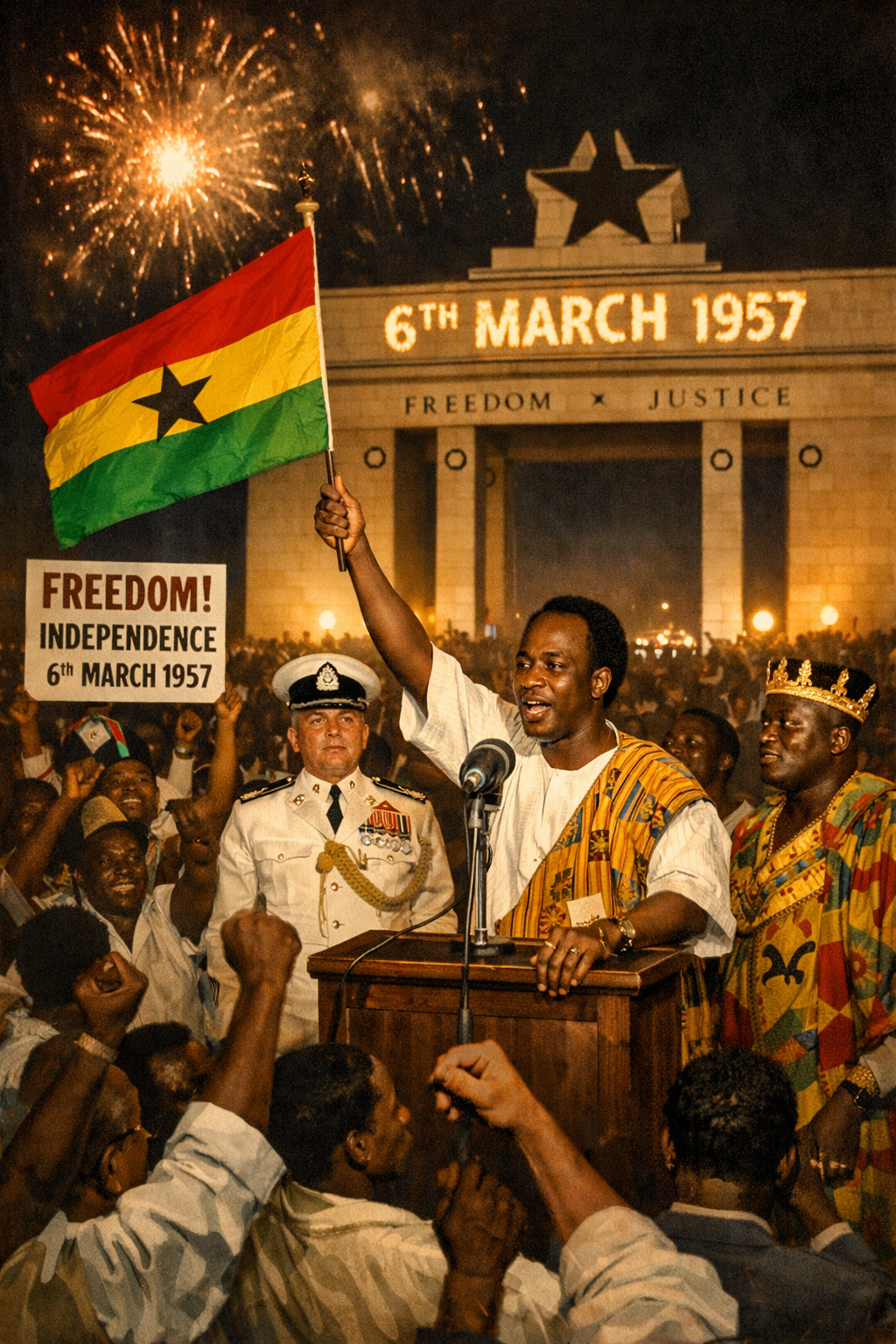
There is a sacred rhythm to the 6th of March, a quiet thunder that echoes across the African continent and wherever the global diaspora finds breath. On that date in 1957, the world witnessed more than a routine transfer of administrative paperwork. It watched an ancient, deeply poetic people step out from the suffocating shadow of the British Empire, tear down the Union Jack, and hoist a flag of radiant red, gold, and green, centered by a single, bold Black Star.
The birth of independent Ghana was the original crack in the armor of Western colonial hegemony south of the Sahara. It was the moment Africa declared to a skeptical, arrogant world that the Black soul was fully capable of governing its own destiny. But to truly honor Ghana Independence Day, one must look past the celebratory parades and gaze into the long, grueling crucible of colonization, systemic exploitation, and the fierce, nonviolent fire that ultimately brought an empire to its knees.
The Shadow over the Gold Coast
Long before European sails broke the horizon of the Gulf of Guinea, the land that is now Ghana was home to sophisticated, highly organized civilizations. Rich Akan kingdoms, including the mighty Ashanti Empire, the Fante confederacies, and the Ga and Ewe states along the coast, possessed complex systems of governance, vibrant trade networks, and magnificent artistic traditions. These indigenous societies practiced consensus-based democracy, where chiefs ruled, held in trust by their communities, and could be destooled if they failed to listen to the council of elders and queen mothers.
Everything shifted with the arrival of European mercantile interests. The Portuguese were the first to erect a permanent fortress at Elmina in 1482, seeking direct access to the vast gold deposits that earned the region the European label of the Gold Coast. Over the next four centuries, the Portuguese, Dutch, Danes, and British turned the coast into a battleground of commercial rivalry, siphoning off immense mineral wealth and participating in the brutal transatlantic slave trade that devastated interior communities.
By the 19th century, Great Britain emerged as the dominant imperial power. Through a mix of military force, coercive diplomacy, and treaties like the Bond of 1844, the British steadily expanded their jurisdiction over coastal chiefs. In 1874, London formally annexed the coastal areas as the Gold Coast Crown Colony. Following decades of fierce, heroic resistance by the Ashanti people, who fought British forces repeatedly to defend their ancestral sovereignty, the British annexed the Ashanti kingdom and the Northern Territories by 1902, consolidating the entire geography under a single colonial apparatus.
Under British rule, the Gold Coast was transformed into a classic extractive colonial economy. The British administration systematically extracted the nation’s rich deposits of gold, bauxite, diamonds, and manganese, while converting vast swathes of fertile land into cocoa plantations. Though local African farmers pioneered the cocoa industry through sheer grit, the profits were heavily skimmed by European buying cartels like the United Africa Company, while local populations endured high import prices, crumbling rural infrastructure, and a complete lack of political self-determination.
The Seeds of Civil Resistance
The narrative that Ghana’s freedom was a peaceful, easy concession handed out by a benevolent British government is a historical myth. The path to independence Ghana walked was forged through decades of relentless, highly organized civil resistance.
As early as 1897, educated elites and traditional rulers joined hands to form the Aborigines' Rights Protection Society. This coalition successfully mobilized mass nonviolent opposition against a colonial bill designed to transform all waste and unoccupied lands into Crown property, forcing the British government to withdraw the measure. It was a monumental victory that preserved indigenous land ownership for future generations.
The economic battlefield erupted again in late 1937 during the famous Cocoa Boycott. Fed up with foreign monopoly firms fixing the buying price of cocoa at artificially low levels while inflating the cost of basic consumer goods, an alliance of peasant farmers, market women, and traditional chiefs organized a massive hold-up of crops. For seven months, over eighty percent of Ghanaian cocoa farmers refused to sell their beans to European buyers, while market women boycotted European merchandise. The strike paralyzed trade, caused losses to British conglomerates, and proved to the masses that withdrawing their cooperation left the colonial administration utterly helpless.
Blood on the Crossroads and the Year of Awakening
The true turning point in the struggle for Ghana independence arrived in the aftermath of the Second World War. Over 65,000 West African soldiers had been recruited to fight for the British Empire in North Africa, Kenya, and the harsh jungles of Burma. Returning home to the Gold Coast, these ex-servicemen found a country plagued by severe inflation, mass unemployment, and a colonial government that reneged on its promises of veteran pensions and social advancement.
On February 28, 1948, a group of unarmed ex-servicemen organized a peaceful march to Christiansborg Castle in Accra to present a petition of grievances to the British Governor. As the peaceful procession approached the military crossroads, a British police officer, Major Imray, ordered his men to open fire on the defenseless veterans. Sergeant Adjetey, Corporal Attipoe, and Private Odartey Lamptey were shot dead on the spot, while several others were severely wounded.
News of the cold-blooded murders swept through Accra like a wildfire. The tragedy coincided with an ongoing anti-inflation boycott organized by a prominent Ga chief, Nii Kwabena Bonne III. Outraged citizens took to the streets, resulting in days of widespread rioting, looting of foreign-owned stores, and the storming of Ussher Fort Prison to free inmates. The riots spread rapidly to towns like Kumasi, Nsawam, and Koforidua, resulting in 29 deaths and hundreds of casualties.
The British administration reacted with panic, arresting six prominent leaders of the newly formed United Gold Coast Convention, including J.B. Danquah and a brilliant, newly returned young organizer named Kwame Nkrumah. The arrest of the “Big Six” backfired spectacularly, transforming them into national martyrs and proving to the entire population that constitutional petitions were no longer enough to secure their dignity.
Kwame Nkrumah and the Fire of Positive Action
Among the Big Six, Kwame Nkrumah possessed an extraordinary, radical vision for the liberation struggle. Born in the small village of Nkroful, Nkrumah had spent years studying in the United States and England, absorbing the Pan-African philosophies of Marcus Garvey, W.E.B. Du Bois, and C.L.R. James while working manual jobs to survive.
Recognizing that the middle-class lawyers of the UGCC were too cautious and out of touch with the working-class masses, Nkrumah broke away in June 1949 to form the Convention People's Party. His slogan was unapologetic and immediate: “Self-Government Now”. He mobilized the “verandah boys”, the urban youth, market women, trade unionists, and elementary school graduates, building the first true mass political movement in sub-Saharan Africa.
In January 1950, Nkrumah launched the historic campaign of Positive Action. Deeply influenced by Mahatma Gandhi's philosophy of civil resistance, Positive Action weaponized nonviolent non-cooperation. Nkrumah called for nationwide general strikes, economic boycotts, press campaigns, and peaceful sit-ins to paralyze the colonial state until the British conceded the right of the people to draft their own constitution.
The strike brought transportation, commerce, and public administration to a complete standstill for three weeks. The British colonial government responded by declaring a state of emergency, raiding party offices, banning newspapers, and throwing Nkrumah and other CPP leaders into Fort James Prison on charges of sedition.
Yet, imprisonment only supercharged Nkrumah’s legend. From inside his prison cell, using scraps of toilet paper smuggled out by sympathetic guards, he continued to direct the party’s strategy. When the British held the country's first general election under universal adult suffrage in February 1951, the CPP achieved a crushing landslide victory, winning 34 out of 38 elected seats. Nkrumah himself won his Accra Central seat with over 22,000 out of 23,000 votes while still sitting in a jail cell. Recognizing the undeniable will of the people, the British Governor, Sir Charles Arden-Clarke, had no choice but to release Nkrumah directly from prison and invite him to form a government as Leader of Government Business, a position that soon evolved into Prime Minister.
The Birth of a Free Nation
For the next six years, Nkrumah navigated the complex, treacherous waters of transitional government, building schools, expanding hospitals, constructing the modern port at Tema, and outmaneuvering political opposition to secure total independence.
The long-awaited midnight arrived on March 6, 1957. Before a crowd of over 40,000 roaring citizens gathered at the Polo Ground in Accra, Kwame Nkrumah stepped to the podium wearing his traditional northern smock and a traditional cap worn by prison graduates. Tears streamed down the faces of men and women who had waited their entire lives for that moment.
As the clock struck midnight, Nkrumah’s voice boomed across the night air, uttering words that would forever alter the course of human history: “At long last, the battle has ended! And thus, Ghana, your beloved country, is free forever!”
He did not view the victory as a purely local achievement. In that same soaring speech, he reminded the world of Ghana's sacred obligation to the rest of the continent, declaring, “Our independence is meaningless unless it is linked up with the total liberation of the African continent”.
Ghana Independence Day remains far more than a simple anniversary on the calendar. It is a monument to a people who proved that nonviolent unity, moral courage, and strategic resistance can shatter the chains of the most powerful empire on earth. The Black Star that rose over Accra in 1957 continues to shine as an eternal symbol of African sovereignty, resilience, and unyielding hope.