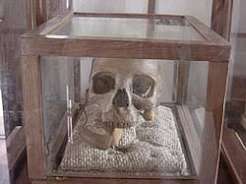
In the late 19th century, as European powers raced to carve up the African continent, they met fierce and sophisticated resistance from indigenous leaders who refused to surrender their sovereignty. Among the most legendary of these figures was Chief Mkwavinyika Munyigumba Mwamuyinga, more commonly known to history simply as Mkwawa. Meaning “conqueror of many lands,” his name perfectly encapsulated his military genius and the formidable power of the Hehe Chiefdom in what is now the Iringa region of Tanzania.
To this day, Chief Mkwawa is remembered not only for his brilliant tactical victories against the German colonial army but also for the profound cultural heritage he left behind. His story is one of fierce independence, tragic sacrifice, and an incredibly bizarre geopolitical quest to return his stolen skull to its rightful resting place.
The Rise of a Warrior King
Born around 1855 in Luhota, Mkwawa was the son of Sultan Munyigumba, the ruler who had initially consolidated the Hehe clans. After Munyigumba's death around 1879, a subordinate ruler of Nyamwezi origin named Mwambambe unlawfully seized political power. Mwambambe targeted Mkwawa and his mother, Sengimba, forcing them to flee into exile in Ugogo. Tragedy struck during their flight when Mkwawa's mother threw herself into the fast-moving waters of the Ruaha River at a location now known as Kikongoma, a site that remains culturally significant to the Hehe people today.
Mwambambe's autocratic rule deeply alienated the Hehe, prompting Mkwawa to return and reclaim his birthright. Mkwawa defeated Mwambambe at the Battle of Ilundamate and firmly established himself as the undisputed mutwa (supreme chief) of the Hehe.
To protect his expanding empire from neighboring tribes and encroaching foreign powers, Mkwawa constructed a massive capital at Kalenga. He called this formidable fortress Lipuli, meaning “strong elephant”. The fortress was an architectural marvel for its time, surrounded by a stone and mud wall that stretched for 13 kilometers and stood 4 meters high. Inside the fort was the Kidunda (Earth Mound), a soil podium from which Mkwawa addressed his warriors, his voice amplified by his spokesperson, Mahanzala Mwakiyombe.
The Battle of Lugalo: Shattering the Myth of European Invincibility
By the 1890s, the German East Africa Company and later the German imperial government began aggressively penetrating the Tanzanian interior. Mkwawa recognized the existential threat this posed to his kingdom and fiercely opposed German colonization.
On August 17, 1891, the German commissioner Emil von Zelewski led a heavily armed battalion of 320 askaris and officers to suppress the Hehe. They were met at Lugalo by Mkwawa's 3,000-strong army. Despite facing modern rifles, the Hehe warriors, armed primarily with spears sharpened on stones like the historic Ipyulilo rock, launched a devastating ambush. Mkwawa's forces quickly overpowered the colonial troops, killing Zelewski and securing one of the most stunning African victories against a European power.
Mkwawa’s military success was backed by deep traditional knowledge and psychological warfare. According to Hehe local histories, Mkwawa utilized a traditional medicine called mbisi, which was secretly mixed with dog meat and fed to his warriors. This ritual was believed to give his fighters the tracking abilities and heightened senses of a hunting dog, allowing them to effectively locate their enemies. Mkwawa himself was an expert in traditional healing, personally treating wounded soldiers on the battlefield by applying chewed leaves of the Msawasa tree to spear wounds before extracting the weapons.
The Fall of Kalenga and the Guerrilla War
The humiliation at Lugalo infuriated the German colonial administration. On October 28, 1894, a heavily reinforced German expedition under Colonel Freiherr Friedrich von Schele attacked the Kalenga fortress. The siege was brutal, resulting in the death of German Lieutenant Eric Maas, whose grave can still be found in Kalenga today. Despite a fierce defense, the superior firepower of the Germans overwhelmed the Hehe, and the fort fell.
Rather than surrender, Mkwawa managed to escape the burning fortress into the surrounding bush. In an act of symbolic defiance, he threw away his fly whisk, an item of royal regalia, at a site in Usungwa now known as Itagautwa (meaning “the place where he threw away the chieftainship”).
For the next four years, Mkwawa waged a relentless campaign of guerrilla warfare against the Germans, utilizing natural hideouts like the Mlambalasi Rock Shelter. His tactical brilliance and the profound loyalty of his people allowed him to evade capture, frustrating the colonial administration, which eventually placed a bounty on his head.
The Ultimate Sacrifice and the Stolen Skull
By July 1898, Mkwawa's forces were depleted, and the German net was closing in. On July 19, 1898, a German patrol led by Sergeant Major Merkl surrounded Mkwawa's camp at the Mlambalasi Rock Shelter. Realizing that escape was impossible, Chief Mkwawa chose to end his own life rather than suffer the indignity of capture and subjugation by his enemies.
When the Germans reached his body, they committed a final act of desecration: they severed Mkwawa's head and sent his skull to Germany as a macabre trophy of their conquest. His headless body was buried by the rock shelter, a site that remains a venerated graveyard today.
The story of Mkwawa's skull, however, was far from over. Following Germany's defeat in World War I, the British took administrative control of the territory. Recognizing Mkwawa's immense symbolic importance to the local population, the British successfully lobbied to have the return of his skull explicitly mandated in international law. Article 246 of the 1919 Treaty of Versailles stated: “Germany will hand over to His Britannic Majesty’s Government the skull of Sultan Mkwawa which was removed from the Protectorate of British East Africa and taken to Germany.”
Despite the treaty, the skull remained missing for decades as German authorities repeatedly claimed it could not be located. It wasn't until 1953 that Sir Edward Twining, the Governor of Tanganyika, personally visited the Museum für Völkerkunde in Bremen to search for it. From a collection of 2,000 skulls, Twining identified Mkwawa's remains by matching the cranial measurements to Mkwawa's grandson and identifying a distinct bullet hole in the back of the head.
The skull was finally repatriated to Tanzania in 1954. In a deeply emotional ceremony on June 19, 1954, it was presented to Mkwawa's grandson, Chief Adam Sapi, before a silent crowd of over 30,000 Wahehe.
An Enduring Cultural Legacy
Today, Mkwawa's legacy is woven deeply into the national identity of Tanzania. The Kalenga Museum, established to house his skull and preserve Hehe military artifacts, stands as a monument to indigenous resistance. The natural and historical landscape of the Msembe area, from the ruins of Fort Kalenga to the Mlambalasi Rock Shelter, continues to serve as a tangible link to his reign.
His name remains a symbol of unyielding courage and anti-colonial pride. Modern Tanzanian institutions proudly carry his name forward, with Mkwawa University College of Education serving as a premier academic institution, ensuring that the history, intellect, and indomitable spirit of the “conqueror of many lands” continues to educate and inspire new generations.