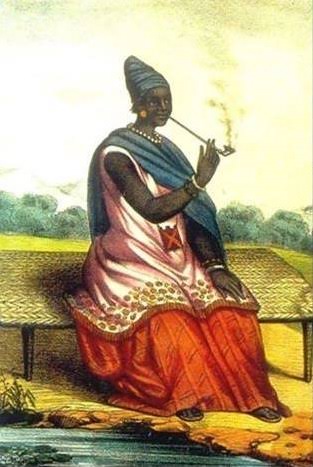
Across the vast landscape of African history, few stories shine as brightly as that of Ndaté Yalla Mbodj, the last great Lingeer (Queen) of the Waalo Kingdom. In an era when European powers were expanding their empires across the continent, this Senegalese sovereign stood at the forefront of the resistance against French colonization and Moorish invasions. Much like the resistance led by other notable historical figures, such as King Béhanzin of Dahomey, whose fearless women's army mirrored the female warriors of Waalo, Ndaté Yalla’s defiance remains one of the most compelling accounts of anti-colonial struggle.
The Wealth and Power of the Waalo Kingdom
Located in what is now northern Senegal and parts of Mauritania, the Waalo Kingdom was one of the oldest and most powerful states in the region, with its roots tracing back to the 11th century. Situated along the delta of the Senegal River, it was a fertile and strategic territory that controlled key trade routes into the African interior.
Before the invasion of the Arabs and the French, Waalo practiced a matrilineal system that granted women equal rights, privileges, and political roles. The Senegalese sovereigns of the Wolof Kingdoms bore the title of “Brak,” while the royal mothers or sisters were known as “Lingeers”. These Lingeers were not merely figureheads; they wielded immense political and military power, often commanding their own armies and succeeding sovereigns to lead their people. The queens of Waalo had to belong to one of three maternal dynasties: the Tédiek, the Loggar, or the Joos.
Like the legendary Dahomey Amazons, the Waalo female warriors were trained at an early age and prepared for war. While some guarded the kingdom, others served the royal women in the palace, and a queen or princess typically led them into battle.
The Making of a Warrior Queen
Born around 1810 into the ruling Mbodj family, Ndaté Yalla was the daughter of Brak Amar Fatim Borso Mbodj and Lingeer Fatim Yamar Khuri Yaye Mbodj. From a young age, she and her older sister, Ndjeumbeut, were trained as warriors and groomed for leadership by their mother, who instilled in them a deep sense of justice and national pride.
The defining moment of her early life occurred during the events of Nder in 1820. While the Brak was away in Saint-Louis receiving medical treatment, Moorish warriors attacked the capital. Lingeer Fatim Yamar bravely led a group of daring women to counterattack and repel the invaders. This strong female military force completely surprised the Moors, who only realized they had been defeated by women after the battle was won. However, when the wounded pride of the Moors drove them to return with overwhelming force, the Lingeer and her companions chose to burn themselves alive rather than endure dishonor. Before doing so, Fatim Yamar ensured the survival of her daughters, 10-year-old Djeumbeut and 12-year-old Ndaté Yalla, so they could carry on the royal lineage.
Ascension to the Throne and Defiance
Following the death of her sister on October 1, 1846, Ndaté Yalla was crowned Queen of the Waalo Kingdom in the capital city of Ndar (now Saint-Louis). She ascended the throne at a time of severe external pressures, particularly from French colonial expansionists who sought to dominate the region.
Ndaté Yalla ruled with an iron hand and immediately established herself as a formidable opponent to the French. In 1847, she opposed the free passage of the Sarakolé people, who supplied Saint-Louis with cattle. Asserting her sovereignty, she sent a powerful letter to the French governor:
“We guarantee and control the passage of cattle in our country, and we will not accept it the other way. Each leader governs his country as he pleases.”
Her resistance was characterized by diplomacy, legal arguments, and outright defiance. Through letters preserved in the National Archives of Senegal, we see a queen who adamantly defended her lands. In a letter from May 23, 1851, she claimed absolute authority over the island of Boyo, stating: “Today, there is no one who can say that this land belongs to them; it belongs to me alone”. In another correspondence dated January 16, 1854, she and her officials demanded accountability from the French over the mistreatment of her subjects, boldly warning that whoever unjustly puts a citizen of Boyo in irons should pay with blood.
The Battle Against Faidherbe
By the 1850s, the French forces were led by Governor Louis Faidherbe, who viewed Ndaté Yalla as a direct obstacle to French commercial and territorial ambitions. Faidherbe utilized a strategy of divide and conquer, exploiting internal divisions within Waalo by bribing local sub-chiefs.
In February 1855, Faidherbe launched a massive military invasion against her kingdom. Before heading into the crucial Battle of Dioubouldy, Queen Ndaté Yalla delivered a stirring speech to her dignitaries:
“Today, we are invaded by the conquerors. Our army is in disarray. The tiedos of the Waalo, as brave warriors as they are, have almost all fallen under the enemy’s bullets. The invader is stronger than us, I know, but should we abandon the Waalo to foreign hands? This country is mine alone!”
Despite fighting valiantly alongside her husband, Marosso Tassé, who commanded the army, the Waalo forces were overwhelmed by the superior weaponry of the French. The French captured the capital, and Ndaté Yalla was exiled to Ndimb in northern Senegal, where she remained until her death in 1860.
An Enduring Legacy
Though her kingdom was absorbed into the colonial system, Ndaté Yalla Mbodj's legacy as a brilliant strategist and a fierce resister lived on. Her son, Sidya Leon Diop, whom she had imbued with a profound sense of nationalist pride, took up the mantle of resistance. Captured by the French as a child, baptized as Léon, and educated in Algiers, Sidya ultimately rejected his colonizers. Returning to Senegal in traditional dress, he led a general uprising against the French in 1869 before being betrayed and deported to Gabon, where he died in 1878.
Today, Ndaté Yalla Mbodj is remembered as an enduring symbol of Senegalese independence and female empowerment. Her courage disrupted the colonial narrative that African governance was weak or illegitimate, proving that sovereignty could be fiercely defended by a woman. Her monumental contributions to the fight against colonialism are immortalized in the history books and honored with a statue in Dagana.