There is a profound, ancestral truth written into the soil of Africa: when you heal the land, you heal the people who live upon it. Long before modern climate summits made environmentalism fashionable, a young woman from the central highlands of Kenya understood that the degradation of nature, the oppression of women, and the tyranny of corrupt political regimes were all branches of the exact same poisonous tree. Her name was Wangari Maathai.
Known across the world as the Tree Mother of Africa, Professor Wangari Maathai transformed a simple, humble act, planting a tree, into a roaring, nonviolent revolution for democracy, human rights, and social justice. From her quiet rural childhood to the international halls of Oslo, the story of Maathai Wangari is a masterclass in moral clarity and unyielding courage.
The Sacred Seed of Ihithe
To understand the spirit of Wangari, one must travel back to the lush, green slopes of Nyeri District in central Kenya, where she was born on April 1, 1940. Raised in the village of Ihithe among the Kikuyu people, young Wangari Muta grew up intimately connected to the earth. Her mother taught her to respect the natural world, showing her that certain ancient trees and clean streams were sacred sanctuaries that should never be disturbed.
Education for African girls during the British colonial era was exceedingly rare, but Wangari Maathai proved to be an extraordinary student. Taught by Catholic missionary nuns, she excelled academically and graduated at the top of her high school class. In 1960, on the eve of African independence, she was selected for the historic Kennedy Airlift program, which brought promising young East Africans to study at universities across the United States.
She earned a Bachelor of Science degree in biological sciences from Mount St. Scholastica College in Kansas in 1964 and a Master of Science from the University of Pittsburgh in 1966. Returning home to a newly independent Kenya, she pursued her doctoral studies and made history in 1971 by becoming the first woman in East and Central Africa to earn a Ph.D.
She joined the faculty at the University of Nairobi, becoming the first female chair of the Department of Veterinary Anatomy and the first female associate professor in the region. Yet, despite achieving the absolute heights of academic excellence, her heart remained tethered to the everyday struggles of the ordinary women living in the rural countryside.
The Birth of the Green Belt Movement
In the 1970s, as a member of the National Council of Women of Kenya, Wangari Maathai began listening deeply to rural women. They spoke of a changing, dying landscape. Local streams were drying up, the soil was washing away into muddy rivers, nutritious food was becoming scarce, and they had to walk further and further every day just to gather firewood for cooking.
Professor Maathai saw a solution that was at once simple, practical, and deeply revolutionary: teach the women to plant trees. On June 5, 1977, marking World Environment Day, she led a procession of women to plant seven trees in a Nairobi park in honor of historical community leaders. That symbolic act marked the official birth of the Green Belt Movement.
The green belt movement encouraged rural women to search nearby forests for seeds of native trees, establish community nurseries, and nurture seedlings. The movement paid the women a small stipend for every seedling that survived, providing impoverished mothers with an independent income while restoring watersheds and stabilizing the soil.
What began as a localized ecological initiative quickly blossomed into a continent-wide phenomenon. Through the Wangari Maathai green belt move, over 30 million trees were planted across farms, schools, and church compounds in Kenya. By 1986, the movement established the Pan-African Green Belt Network, inspiring similar reforestation and community empowerment programs in Tanzania, Uganda, Malawi, Ethiopia, and Zimbabwe.
For Maathai, planting a tree was never just about forestry. It was an entry point for civic education. It taught disenfranchised women that they possessed the inherent power to repair their own environment and hold their leaders accountable.
Standing Unbowed Against Dictatorship
As the Green Belt Movement grew into a powerful voice for ordinary citizens, it inevitably collided with the autocratic regime of Kenyan President Daniel Arap Moi. The single-party government looked at Maathai’s mobilization of women with intense hostility, viewing her demand for environmental justice as a direct political threat.
In late 1989, President Moi announced a plan to build a massive, 60-story skyscraper complex right in the middle of Uhuru Park, the premier public green space in central Nairobi. The project was to feature a massive statue of the president himself. Outraged by the privatization of public land, Wangari Maathai wrote impassioned letters of protest to government officials, foreign diplomats, and international organizations.
In response, government officials publicly vilified her, calling her a crazy woman, questioning her morality, and suggesting she should be quiet and obey men according to traditional customs. Members of Parliament went so far as to label the Green Belt Movement a bogus organization of divorcees. Undeterred, Maathai took the government to court to block construction. Her persistent campaign created an international outcry that ultimately forced foreign investors to pull their funding, saving Uhuru Park for future generations.
Her defiance only grew bolder. In 1992, Maathai joined mothers of political prisoners at Uhuru Park in a hunger strike demanding the release of their sons. Police brutally attacked the peaceful protesters, knocking Maathai unconscious and hospitalizing her. When the government attempted to carve up Karura Forest and hand the public land to political cronies in 1999, Maathai led supporters into the forest to plant trees, where she was violently beaten by armed thugs while police stood by and watched.
Throughout these years of terror, Wangari Maathai was arrested repeatedly, imprisoned, placed under surveillance, and subjected to character assassination. Yet, she refused to be silenced. She famously drew strength from the story of the tiny hummingbird that tries to put out a massive forest fire one drop of water at a time while larger animals stand by in despair. She insisted that no matter how small our effort seems, we must do the best we can.
A Historic Nobel Honor and Global Legacy
With the return of multi-party democracy to Kenya, Wangari Maathai’s decades of sacrifice were triumphantly vindicated. In December 2002, she ran for Parliament representing the Tetu Constituency and won an astonishing 98% of the vote. She was subsequently appointed Assistant Minister for Environment, Natural Resources, and Wildlife.
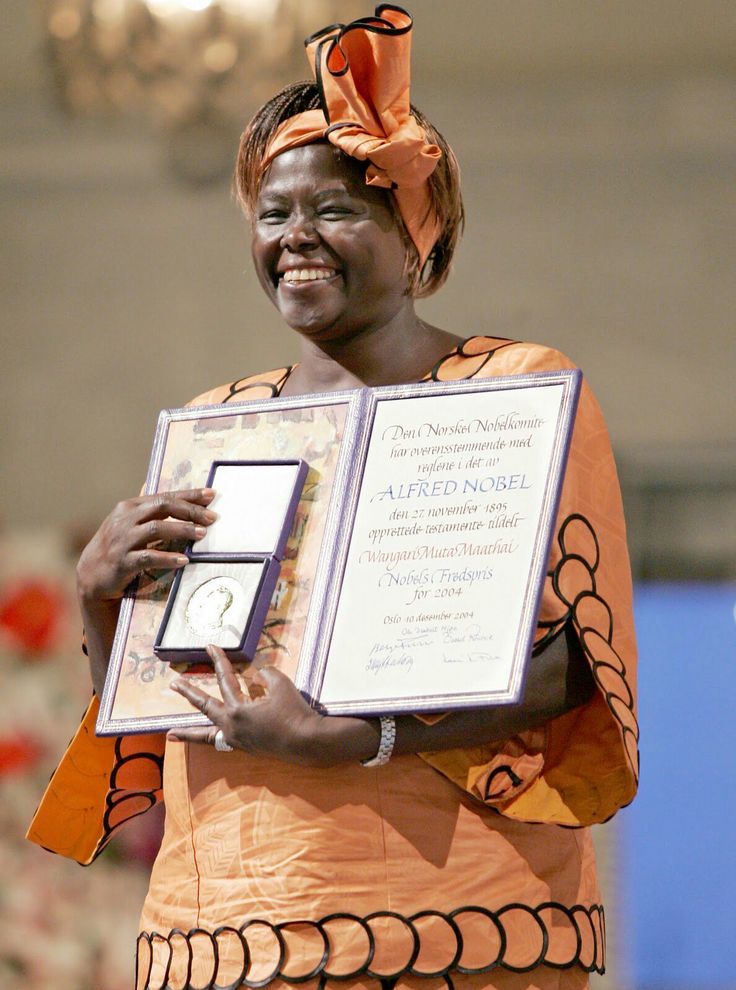
International recognition reached its absolute peak in October 2004, when the Norwegian Nobel Committee announced that the Wangari Maathai Nobel prize would be awarded for her immense contribution to sustainable development, democracy, and peace.
The award was a historic milestone. She became the very first African woman and the first environmentalist in history to be honored with the Nobel Peace Prize. The committee recognized what Maathai had championed for decades: that peace cannot exist without fair resource management, and that protecting the environment is inseparable from defending human rights and democracy. The announcement of the Maathai Wangari Nobel prize electrified the African continent, proving that grassroots commitment could change the world.
Professor Maathai used her global platform to advocate for climate justice, the protection of the Congo Basin rainforest, and debt relief for developing nations through the Jubilee 2000 campaign. She co-founded the Nobel Women's Initiative and authored four acclaimed books, including her celebrated memoir, Unbowed.
On September 25, 2011, Wangari Maathai passed away in Nairobi from complications of ovarian cancer at the age of 71. In accordance with her lifelong values, she explicitly requested that she not be buried in a wooden coffin so that no tree would be cut down for her burial; instead, she was laid to rest in a eco-friendly casket made of bamboo and papyrus.
Today, the legacy of Wangari Maathai lives on in every green canopy across Africa and in the hearts of millions who dare to stand up for justice. She proved that true leadership does not require grand armies or vast fortunes. It only requires a courageous heart, an unyielding faith in human dignity, and the patience to plant a single seed in the earth.