The Kiriji War
The Kiriji War, commonly referred to as the Ekiti Parapo War, stands as one of the most defining and tumultuous periods in the history of the Yoruba people. Lasting for sixteen exhaustive years, from July 1877 to March 1893, it holds the record as the longest civil war ever fought on Yoruba soil, and arguably the longest ethnic civil conflict in the world.
This monumental clash essentially split the Yoruba people into two main opposing factions. On one side stood the Western Yoruba, primarily composed of the military powerhouse of Ibadan and its Oyo-speaking allies. Opposing them was the Eastern Yoruba alliance, a confederacy comprising the Ekiti, Ijesha, Ijebu, Igbomina, and Akoko peoples, which became famously known as the Ekiti-Parapo. What began as a local rebellion against oppressive taxation and administrative abuse rapidly escalated into a full-scale war of independence, ultimately reshaping the political map of Yorubaland and paving the way for British colonial intervention.
The Distant Cause: The Fall of the Oyo Empire
To fully understand the roots of the Kiriji War, one must look back to the collapse of the Old Oyo Empire in the late 18th and early 19th centuries. For over two centuries, Oyo had functioned as the political, commercial, and cultural center of Yoruba civilization, maintaining equilibrium and relative peace among the various kingdoms. However, internal decay and external pressures, most notably the systematic jihadist invasions by the Fulani from Ilorin, led to the empire's disintegration.
The fall of Oyo created a massive power vacuum. Out of the ashes rose new refugee settlements and military states, with Ibadan quickly emerging as the most dominant. Founded as a war camp, Ibadan successfully defended the eastern Osun districts against the Ilorin Fulani, scoring a decisive victory at the Osogbo War in 1840. With its military prowess confirmed, Ibadan began to envision itself as the rightful successor to the Oyo Empire, attempting to unify Yorubaland under a centralized, militaristic government.
Ibadan Hegemony and the Oppressive Ajele System
As Ibadan expanded its territories, it conquered much of the Ekiti, Ijesha, Igbomina, and Akoko regions. However, unlike the loose confederations to which these kingdoms were accustomed, Ibadan imposed a strict, centralized administrative structure. Conquered towns were placed under the oversight of a metropolitan chief in Ibadan, known as a Baba-kekere.
Because Ibadan lacked the resources to maintain a standing army in every subject town, it instituted the Ajele system. Ajeles were resident political agents or administrators stationed in the vassal towns to ensure loyalty, collect heavy tributes, and forward them to the Aare Ona Kakanfo (the generalissimo) in Ibadan.
Over time, this system became synonymous with tyranny. Many Ajeles were corrupt, greedy, and operated with absolute impunity. They treated the local chiefs with contempt, made outrageous demands for food and livestock, forcefully appropriated farmlands, and subjected the locals to forced labor. Furthermore, the Ajeles and their messengers were known to forcefully take wives and daughters, committing heinous abuses in the presence of the women's husbands and fathers. For several decades, the eastern kingdoms were impoverished and humiliated by this master-slave political arrangement.
The Spark that Ignited the Rebellion
The tension that had simmered for years finally boiled over in 1877 in the town of Okemesi (formerly Imesi-Igbodo). The immediate catalyst was a personal grievance that escalated into a regional uprising.
Prince Fabunmi, a brave and respected local militia leader, was celebrating his annual Erinle festival with friends and age-grade members at a local shrine. During the festivities, a group of unruly Ajele messengers intercepted palm wine meant for the celebration, invaded the shrine armed with weapons, and brazenly assaulted a woman, who, depending on the historical account, was either Fabunmi's wife, Falola, or the wife of a close friend.
Enraged by this gross indignity and the desecration of the festival, Fabunmi rushed home, armed himself with a sword, and marched to the Ajele’s compound. He indiscriminately executed the Ajele and members of his household. Knowing the severe consequences of his actions, Fabunmi quickly sent emissaries to all known warriors across Ekiti, Ijesha, Akoko, and Igbomina, urging them to unite for a final, massive uprising against their Ibadan oppressors.
The news of Fabunmi's revolt acted like a match to a powder keg. Across the eastern Yoruba lands, long-oppressed citizens rose, resulting in the widespread massacre, expulsion, or enslavement of Ibadan officials.
The Formation of the Ekiti-Parapo Confederacy
Realizing that no single kingdom could withstand Ibadan's retaliatory wrath, the eastern Yoruba kingdoms united to form a formidable military alliance known as the Ekiti-Parapo (meaning “Ekiti Together” or “Ekiti Union”).
The confederacy was not merely an army; it was a multi-state organization heavily supported by the Ekiti-Parapo Society in Lagos. This society, composed of educated emigres and wealthy merchants of Ekiti and Ijesha descent, provided crucial financial backing, modern warfare strategies, and a steady supply of advanced weaponry.
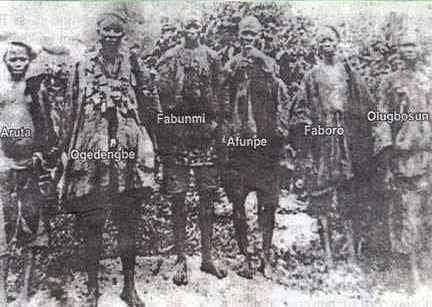
To lead this massive force, Prince Fabunmi initially took command, but he soon deferred to a more senior and legendary tactician: Ogedengbe Agbogungboro of Ilesha. Ogedengbe, who had received military training in Ibadan and was well-versed in their tactics, became the Commander-in-Chief (Seriki) of the Ekiti-Parapo forces. Under his leadership, the confederacy transformed into a disciplined and highly effective military machine.
Tactics, Weaponry, and the “Kiriji” Sound
The Kiriji War was characterized by advanced military tactics and the introduction of devastating new weaponry, making it one of the most technologically advanced conflicts in 19th-century West Africa.
Initially, the Ekitis suffered defeats, most notably at the Jalumi War (Battle of Ikirun) in 1878, where Ibadan forces routed the allied troops, driving many Ilorin soldiers into the Otin River. However, the Ekiti-Parapo quickly adapted.
They utilized the steep, rugged terrain of the Ekiti hills to their advantage, establishing their main camp at Imesi-Ile. They developed a sophisticated spy network headquartered in Ilara-Mokin and used animal behavior to signal enemy movements. Furthermore, they dug extensive defensive trenches, a tactic that forced the war into a prolonged stalemate.
The most defining feature of the war, however, was the weaponry. Through the Ondo road and the port of Benin, the Ekiti-Parapo imported modern breech-loading firearms, Snider rifles, Martini-Henry rifles, and Winchester repeaters from Hamburg, Germany. They also acquired large-muzzled flintlock cannons. When these massive cannons were fired, the thunderous explosion echoed across the valleys and mountains, producing a deafening “Ki-ri-ji-i” sound. This terrifying onomatopoeia gave the conflict its famous name: the Kiriji War.
Ibadan, blockaded by the Egba and Ijebu from accessing coastal trade routes, struggled to match this firepower and was forced to rely on traditional mud-wall defenses and older weapons, although they too eventually secured some supplies via Lagos.
Notable Leaders and Commanders
The conflict produced several legendary figures whose names are still revered in Yoruba history:
- Ogedengbe of Ilesha: The charismatic and brilliant Seriki of the Ekiti-Parapo. He brought discipline and unity to the confederate forces and was highly respected by all kings and chiefs.
- Prince Fabunmi of Okemesi: The courageous warrior whose initial act of defiance sparked the war. He gracefully stepped down from supreme command for Ogedengbe but remained a crucial battlefield general.
- Aare Obadoke Latoosa: The Aare Ona Kakanfo (Generalissimo) of Ibadan. A fierce, proud, and ambitious leader who sought to crush the rebellion and bring all of Yorubaland under Ibadan's control. He died at the war camp in Igbajo in 1885, a major turning point in the conflict.
- Alfred Labinjo: A native of Imesi-Ile and a resident of Lagos who returned to lead the elite Ekiti-Parapo Rifle Corps, bringing modern warfare expertise to the frontlines until his death in battle in 1885.
Life at the War Camps
As the war dragged on, the primary military camps evolved into massive, functional cities. The Ekiti-Parapo camp at Imesi-Ile and the Ibadan camp at Igbajo were situated on two high hills facing each other, separated by a deep valley.
The Confederate camp at Imesi-Ile housed approximately 40,000 people, while the Ibadan camp held up to 60,000. These populations included not only soldiers but also a large number of wives, children, traders, and blacksmiths. The camps had designated shrines, such as the Ogun shrine for the god of iron, and active smithies where weapons were manufactured and repaired.
Women played a vital role in sustaining the war effort, engaging in trading and ensuring food supplies reached the front lines. The primary water sources, the Alapoto and Fejeboyu streams, became legendary. The Fejeboyu stream (meaning “to wash one's face in blood”) was formerly called Eleriko but was renamed after it became so saturated with the blood of wounded warriors that the water turned red.
Remarkably, despite the length and bitterness of the war, there were codes of conduct. Historians note that the conscious killing of women and children was avoided, reflecting a high degree of cultural civilization even amidst the brutality of a civil war.
Attempts at Peace and the 1886 Treaty
As the 1880s progressed, the war settled into a grueling stalemate. Ibadan was stretched incredibly thin, fighting on five different fronts: the Ekiti-Parapo to the east, the Ilorin Fulani to the north, the Egba and Ijebu to the south, and the Ife at Modakeke.
Exhaustion began to set in on both sides. Trade was paralyzed, agriculture was severely disrupted, and the continuous loss of life took a heavy toll. Several peace attempts were made by the Ooni of Ife, the Awujale of Ijebu, and various Lagos elites, but deep-seated mistrust prevented any resolution.
The death of Aare Latoosa in 1885 broke the morale of the Ibadan army, creating an opportunity for decisive diplomacy. Simultaneously, the British, motivated by their own economic interests and the desire to secure trade routes for the Lagos colony, decided to intervene.
In 1886, the Governor of Lagos dispatched special commissioners, alongside Yoruba Christian missionaries like Rev. Samuel Johnson and Charles Philips, to mediate. On September 23, 1886, a formal Proclamation of Peace was signed at Imesi-Ile.
The treaty guaranteed the independence of the Ekiti, Ijesha, Igbomina, and Akoko kingdoms, demanding that Ibadan dismantle its imperial control over these regions. It also included clauses for the evacuation of Modakeke and the cessation of hostilities across various fronts.
The Aftermath and Impact on Yoruba Identity
Despite the 1886 treaty, deep mistrust lingered. Both armies refused to completely dismantle their camps and return home until 1893, when British Governor Gilbert Carter physically visited the camps and enforced the final dispersal of the troops.
The consequences of the Kiriji War were profound:
- Redrawing the Political Map: The war successfully halted Ibadan's imperial expansion and preserved the autonomy of the eastern Yoruba kingdoms. It replaced the threat of a unitary military dictatorship with a recognition of regional confederacies.
- British Colonization: The constant warfare and the subsequent reliance on British mediation provided the perfect excuse for the British Empire to annex Yorubaland. By 1893, southwestern Nigeria had effectively become a British protectorate, transitioning the region from indigenous military rule to colonial administration.
- Formation of Modern Yoruba Identity: While the war was a period of intense internal division, the shared trauma, subsequent reconciliation, and the eventual colonial umbrella fostered a renewed sense of collective Yoruba consciousness. The interactions and alliances formed during the Kiriji War laid the groundwork for a broader pan-Yoruba ethnic identity that emerged in the 20th century.
Conclusion
The Kiriji War was far more than a regional skirmish; it was a defining epoch that tested the resilience, strategic brilliance, and cultural unity of the Yoruba people. Triggered by the oppressive Ajele system, the sixteen-year conflict demonstrated the lengths to which people will go to secure their freedom.
Today, the hills of Imesi-Ile, the legendary Fejeboyu stream, and the memories of commanders like Ogedengbe and Fabunmi serve as enduring testaments to this epic saga. The Kiriji War remains a powerful reminder of the destructive cost of imperialism and the unyielding human desire for autonomy and respect.