When history books recount the clash between ancient Africa and Rome's expanding imperial appetite, the narrative almost always halts at the northern edge of the continent. Western historians love to linger on the tragic final days of Egypt’s Cleopatra VII, painting her death in 30 BCE as the definitive curtain call for African sovereignty against the legions of Augustus Caesar. But just south of the First Cataract of the Nile, where the desert sands meet the fertile heartlands of Nubia, an entirely different story was waiting to be written.
In the ancient kingdom of Kush, located in modern-day Sudan, there reigned a monarch who did not surrender, negotiate away her crown, or swallow poison. Her name was Queen Amanirenas.
Known formally in Meroïtic inscriptions as Amnirense qore li kdwe li (Ameniras, Ruler and Kandake), she was a towering figure of anti-imperial resistance. When Rome sought to push its borders deeper into Africa, Kandake Amanirenas took up the sword, led 30,000 warriors onto the battlefield, lost an eye in combat, and forced the greatest military empire of its time to sue for peace.
This is not a myth. It is the factual, unvarnished history of an African queen who buried the face of Caesar beneath the feet of her people.
The Legacy of the Kandakes: Women Who Ruled and Waged War
To understand Queen Amanirenas of Kush, one must first understand the unique political and spiritual culture of Meroë, the capital of the kingdom of Kush. Unlike many ancient civilizations where royal women were relegated to political marriages or secondary roles, Kush developed a centuries-old tradition of powerful female co-rulers and regnants known as Kandakes (often Latinized as Candace).
The title Kandake signified a supreme queen mother or ruling queen who exercised absolute administrative, religious, and military authority. Archaeological bas-reliefs dating as far back as 170 BCE depict earlier Kandakes, such as Shanakdakheto, clad in battle armor and wielding spears in combat. Other famed Kandakes in this prestigious lineage included Amanishakhete, Amanitore, and Nawidemak.
When Queen Amanirenas ascended the throne around 40 BCE alongside her husband, King Teriteqas, she stepped into this formidable tradition. Her name itself, derived from Amani, the Nubian name for the supreme deity Amun, proclaimed her divine mandate to protect her land and her people. In Meroïtic political structure, the Kandake was the living guardian of the realm, a woman whose willingness to govern was matched only by her readiness to wage war.
The Spark of War: Rome’s Fatal Miscalculation
Following the fall of Cleopatra and Mark Antony in 30 BCE, Egypt was transformed into a personal province of the Roman Emperor, Augustus Caesar. Rome’s newly appointed provincial governors soon turned their sights southward toward Nubia, seeking to exploit its famous gold mines, trade routes, and agricultural wealth.
The Roman prefect of Egypt, Cornelius Gallus, attempted to impose heavy direct taxation on Lower Nubia, a border zone historically controlled by Kush. To the Kushites, who had maintained their independence for thousands of years, paying tribute to an overseas empire was completely unthinkable.
In 25 BCE, an opportunity presented itself. The new Roman prefect of Egypt, Aelius Gallus, withdrew a significant portion of his garrisons to lead an ill-fated military campaign in Arabia.
Seeing her enemy’s vulnerability, Amanirenas acted with decisive tactical brilliance. Partnering with her son, Prince Akinidad, she rallied an army of thirty thousand Kushite soldiers and launched a sweeping surprise invasion of Roman-occupied Upper Egypt.
The Sack of Syene and the Buried Head of Caesar
The Kushite army swept through the Nile Valley like a desert storm. Armed with long ox-hide shields, swords, axes, and deadly archers, Amanirenas captured the strategic Roman-held cities of Syene (modern Aswan), Elephantine, and Philae.
The Kushites overthrew the Roman garrisons, took hundreds of Roman citizens as prisoners of war, and looted the cities. But their most calculated act of political defiance was directed at the bronze and marble statues of Emperor Augustus that had been erected to symbolize Roman dominance.
The Kushite troops toppled the statues, carried the bronze fragments back to Kush, and executed a masterclass in psychological warfare. Queen Amanirenas ordered the severed bronze head of Augustus Caesar to be taken to the capital city of Meroë. There, instead of melting it down for metal, she had it buried directly beneath the stone threshold of a temple dedicated to Victory.
For centuries, every time a Kushite priest, royal, or citizen entered the temple, they stepped directly on the head of the Roman Emperor. The artifact, known today as the Meroë Head, was excavated by British archaeologist John Garstang in 1910. Because it was preserved underground for two millennia, its inlaid glass and calcite eyes remain startlingly intact, a quiet testament to the day an African queen put Rome under her heel.
The One-Eyed Lioness Confronts the Legions
The humiliation at Syene sent shockwaves through the Roman Empire. Augustus immediately appointed Gaius Petronius as the new prefect of Egypt, ordering him to march south with a formidable force of nearly ten thousand veteran infantry and eight hundred cavalry to re-establish control.
What followed was a brutal, five-year conflict (25 BCE – 22 BCE) known as the Meroïtic-Roman War. Petronius managed to push the Kushite forces back into Nubia, capturing cities like Pselchis and Premnis (Qasr Ibrim), and eventually sacking the sacred city of Napata. During the heavy fighting, Kandake Amanirenas suffered a severe injury, losing one of her eyes to an arrow or blade.
In classic historical accounts written by the Greek geographer Strabo, the chronicler attempts to minimize Roman setbacks while describing Queen Amanirenas with a mix of awe and discomfort, portraying her as a masculine sort of woman and blind in one eye.
Yet, far from weakening her resolve, the loss of an eye seemed to heighten her fury. Even after losing her husband, King Teriteqas, early in the conflict, and later her son, Prince Akinidad, on the battlefield, the one-eyed Kandake refused to bend. She adapted her strategy, shifting to guerrilla warfare and utilizing the harsh terrain of the Nile cataracts to exhaust the Roman legions.
In 22 BCE, when Petronius garrisoned a heavy force at Premnis, Amanirenas marched back north with many thousands of men, threatening to annihilate the Roman stronghold. Realizing that conquering the kingdom of Kush would require an endless, bloody war of attrition deep in Africa, Petronius halted his offensive and agreed to hear her ambassadors.
The Treaty of Samos: Forcing Rome to Sue for Peace
Instead of demanding an unconditional surrender, Queen Amanirenas sent her ambassadors to meet Emperor Augustus directly on the Greek island of Samos, where he was stationed at the time. As a diplomatic gesture of ultimate confidence, her envoys reportedly presented the Roman leaders with a bundle of golden arrows, delivering a clear message: If Caesar wants peace, these arrows are a gift of friendship. If he wants war, he will need them.
Faced with a fierce, unbreakable kingdom and a sovereign who refused to capitulate, Augustus made unprecedented concessions.
In the historic Peace Treaty of Samos (signed around 21/20 BCE):
- Total Tax Exemption: The kingdom of Kush was entirely exempted from paying any tribute or taxes to the Roman Empire.
- Territorial Withdrawal: Augustus ordered the Roman army to evacuate its border garrisons, pulling the Roman frontier back north to Hiere Sycaminos (Maharraqa) and returning contested lands to Kush.
- Recognition of Sovereignty: Rome formally recognized the independence and territorial integrity of Kush.
While client kingdoms across Europe, Asia, and North Africa were forced into vassalage by Roman power, Queen Amanirenas secured a peace treaty so favorable that the southern border of Roman Egypt remained tranquil for nearly three centuries.
The Hamadab Stela and an Eternal Legacy
The victory of Kandake Amanirenas was recorded not only in Roman chronicles, but in the stone monuments of Kush itself. In 1914, archaeologists at Hamadab discovered a massive, two-meter-tall sandstone stela that had originally stood at the doorway of a Meroïtic temple.
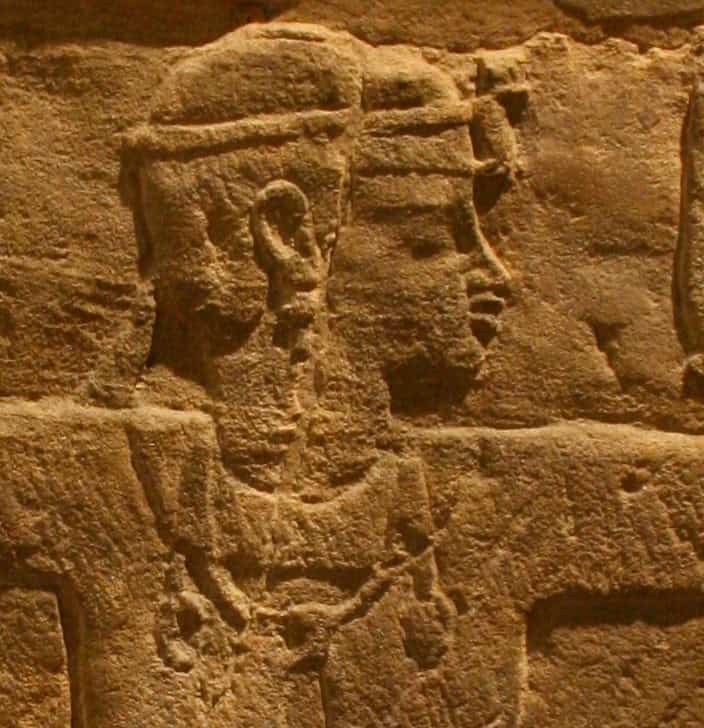
Written in forty-five detailed rows of cursive Meroïtic script, the Hamadab Stela features an incised carving of Queen Amanirenas and Prince Akinidad standing triumphantly alongside the deities Amun and Mut, with shackled prisoners carved beneath their feet. The inscription includes the Meroïtic word Areme, the Kushite name for Rome. Though scholars are still fully deciphering the Meroïtic language, the stela stands as the indigenous, African record of a victorious campaign against an invading empire.
Queen Amanirenas passed away around 10 BCE, leaving behind an empire that was wealthy, sovereign, and feared throughout the ancient world.
Her story is a foundational chapter in the narrative of African self-reliance and anti-colonial resistance. At a time when empires believed they could carve up the continent at will, this one-eyed warrior queen stood at the gates of Nubia, drew her sword, and proved that African freedom is a divine, non-negotiable right.