Timbuktu: The African City That Was Basically Harvard — Before Harvard Existed
Timbuktu: The African City That Was Basically Harvard — Before Harvard Existed
Timbuktu wasn't the middle of nowhere. It was Africa's Harvard a city of 25,000 students, 700,000 manuscripts, and a golden age the world tried to forget.
If someone calls you "basic," tell them this: at a time when Europe was drowning in the Black Plague and couldn't figure out basic sanitation, there was a city in West Africa running a university with 25,000 students, trading hundreds of thousands of manuscripts, and hosting scholars from Cairo, Baghdad, and beyond. That city? Timbuktu. And no, it wasn't a myth. It wasn't a fairy tale whispered by overcreative historians. It was the real deal the intellectual capital of the medieval world, hiding in plain sight on the edge of the Sahara Desert.
Buckle up, because this one will rewire your thoughts.
The Name You've Been Using Wrong
Let's start with the insult. Somewhere along the line, Western culture turned Timbuktu into slang for nowhere. As in, It's so far away, it might as well be Timbuktu.You've probably heard it, maybe even said it. The irony? Timbuktu wasn't the edge of nowhere. It was the centre of everything trade, learning, culture, and prestige during Africa's golden age. The very people who turned it into a punchline were the ones whose own explorers risked their lives trying to reach it, because they'd heard stories of unimaginable wealth and knowledge.
That's not nowhere.That's somewhere so legendary it broke European imaginations.
The City That Built Itself on Books (Not Just Gold)
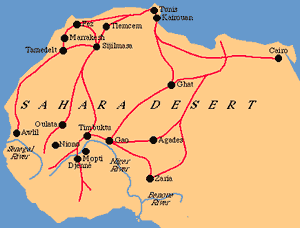
Founded around the 12th century near the Niger River in modern-day Mali, Timbuktu started as a small seasonal settlement a pit stop for Tuareg nomads crossing the Sahara. But geography is destiny. Timbuktu sat at the crossroads of north-south and east-west trade routes, making it the ultimate meeting point for salt from the Sahara, gold from West Africa's interior, and goods from the Mediterranean. Money followed, and where money flows, people build things.
By the 14th and 15th centuries, Timbuktu had hit its golden age. And here's the plot twist that most people miss: it wasn't just the gold that made Timbuktu legendary it was the books.
The Sankore University (also called the Sankore Madrasa) wasn't just a school. It was an intellectual empire. At its peak, it enrolled 25,000 students in a city of roughly 100,000 people. Think about that ratio. One in every four people in the city was in school. Meanwhile, Oxford University, founded in 1096, was still figuring itself out. Timbuktu was already producing astronomers, mathematicians, physicians, theologians, and legal scholars who were writing texts that the rest of the world was reading centuries later.
The Manuscript Situation Is Wild
Here's the detail that will make your jaw drop: Timbuktu accumulated somewhere between 700,000 and 1 million manuscripts over the course of its history. These weren't grocery lists. These were advanced treatises on astronomy, medicine, mathematics, Islamic law, diplomacy, and governance written mostly by African scholars, in Arabic. Some of these manuscripts described surgical procedures, mapped star systems, and laid down legal frameworks that were ahead of their time by centuries.
Many were hidden in family libraries across Mali, tucked away in sandstone walls and underground chambers to protect them from invaders. Today, there is a race against time to digitise and preserve them before the desert, conflict, and neglect finish the job that colonialism started.
These manuscripts aren't just historical artefacts. They're evidence hard, written, dated, academic evidence that Africa was never the dark continent. That was always a lie told by people who hadn't done their research. And the irony? Timbuktu had the receipts all along.
The Trade Routes That Built an Empire
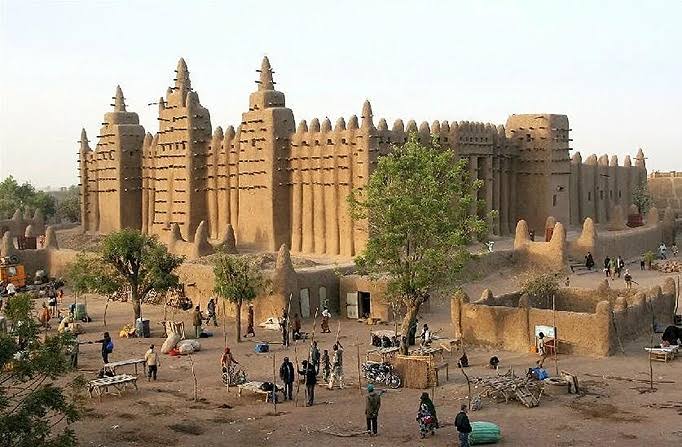
You can't talk about Timbuktu without talking about the empires that fuelled it. The city passed through the hands of the Mali Empire and later the Songhai Empire two of the most powerful states in medieval African history. It was Mansa Musa, the Mali emperor (yes, the same one who crashed Egypt's economy with too much gold on his 1324 pilgrimage to Mecca), who supercharged Timbuktu's growth. After returning from Hajj, he brought back an architect from Andalusia named Es-Saheli, who built the iconic Djinguereber Mosque a structure still standing today.
Musa also brought back scholars. And those scholars brought students. And those students brought more manuscripts. Timbuktu became a magnet for brilliance.
Under the Songhai Empire, led by the formidable Askia Mohammed Toure, Timbuktu reached even greater heights. Askia built an empire stretching across modern-day Mali, Niger, Burkina Faso, Nigeria, and beyond with Timbuktu as its intellectual core. Trade, governance, and scholarship were so intertwined in Timbuktu that the city essentially ran itself as a self sustaining civilisation.
How It Fell And Why We Should Be Angry
Every great story has a villain. Timbuktu's came in 1591, when a Moroccan army crossed the Sahara and defeated the Songhai Empire. Scholars were exiled or killed. The book trade collapsed. Trade routes shifted toward the Atlantic coast, where European powers were now dominating commerce through the slave trade. That reorientation from internal African trade networks to European controlled coastal trading began the slow death of Timbuktu's influence.
By the time French colonial forces arrived in 1893, the city was a shadow of its former self. French colonialism didn't just take land; it took the narrative. Timbuktu got written out of the global story of great cities, and for generations, its name became a joke.
That should make you furious.
Why Timbuktu Matters Right Now
We live in an era where people search Google more than they read books and what people are searching tells a story. Searches for African history, ancient African civilisations, and African empires have surged, especially among young Africans and the diaspora reclaiming what was hidden from them. Timbuktu sits right at the centre of that awakening.
Because Timbuktu isn't just history. It's a mirror. It reflects what African civilisation is capable of when it is allowed to grow on its own terms without interruption, without extraction, without someone else writing the narrative. It shows us that African excellence isn't new. It wasn't imported. It wasn't a surprise. It was always there, written in manuscripts that are still being dug out of sandstone walls today.
So next time someone uses Timbuktu as a punchline for the middle of nowhere, correct them. Not aggressively. Just with facts. Tell them it was once the intellectual capital of the world. Tell them it had 25,000 university students. Tell them it built a civilisation that scholars in Cairo, Baghdad, and across the Muslim world travelled to learn from.
Then ask them: Where was your city in 1400?
Latest Posts
Timbuktu: The African City That …
03 Apr, 2026
We Were Here First: Africa …
21 Feb, 2026