We Were Here First: Africa as The Cradle of Humanity
We Were Here First: Africa as The Cradle of Humanity
Africa is the origin point of Homo sapiens. Learn how 2025 archaeological breakthroughs in Ethiopia and Morocco confirm Africa as the laboratory of humanity.
📍TL;DR
- The Timeline: Human history didn't start 3,000 years ago with Greece or Rome; it began 300,000 years ago in Africa.
- The 2025 Breakthrough: New fossil evidence from Ledi-Geraru, Ethiopia, confirms that multiple human species coexisted 2.8 million years ago, proving evolution is a branching tree, not a straight line.
- The Biological Truth: 100% of living humans—regardless of race or geography—carry DNA that originates from the same African soil.
- The Perspective Shift: The era of colonialism represents less than 0.1% of the total human story. You don’t come from a continent without history; you come from the continent where history was born.
The "Origin Story" Rewrite
Every civilization you were taught to admire, from Greece and Rome to Mesopotamia... all came after Africa. Long after.
Before those first temples were built, before their first alphabet was scratched into clay, before any of the stories the Western world calls "ancient history" even began, human beings were already walking, thinking, and evolving on African soil.
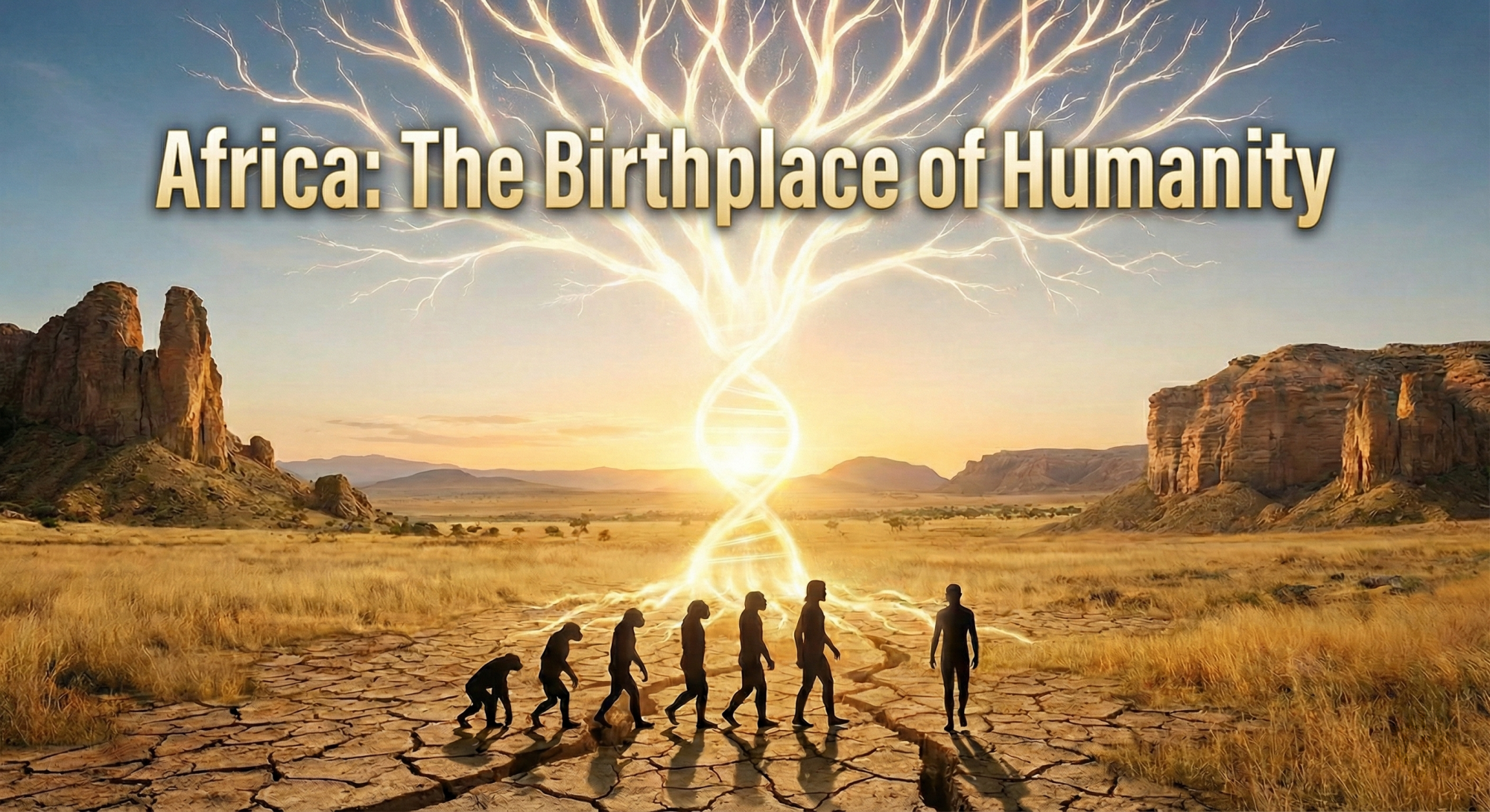
This is not just theory. We're not rewriting history. It’s the finding of every credible paleontologist, geneticist, and archaeologist who has spent serious time with the evidence. Homo sapiens emerged in East Africa approximately 300,000 years ago. Pre-human skeletons found on the same continent date back 4 to 5 million years. And in August 2025, a team of researchers at Arizona State University published findings from the Ledi-Geraru site in Ethiopia's Afar Region that pushed the story even further.
They unearthed fossilized teeth proving that two distinct hominin species were living side by side 2.6 to 2.8 million years ago! This single discovery turns the entire evolution story on its head. It’s telling us we do not have a single line of evolution. It’s a branching tree, with roots deeply planted in Africa.
Nature ran multiple experiments on what it meant to be human, and it ran them all in Africa. We were the laboratory, the cradle, and the first home of every single person alive today. The story of humanity is an African story first. Everything else is chapter two.
A Morning 300,000 Years in the Making
Picture this. A woman stands at the edge of a riverbank somewhere in what we now call Morocco. The air is thick with heat. The grass around her is tall and golden. She's not thinking about history. She doesn't know she’s becoming one. She's thinking about water. About the child on her hip. About the sound she heard in the brush twenty feet away that made her stop walking.
She is, as far as we can tell, one of the earliest members of our species. Homo sapiens. Us. And she is standing in Africa.
We don't know her name. We never will. But in 2017, her bones — along with those of four others — were pulled from a cave called Jebel Irhoud in Morocco, and they changed everything scientists thought they knew about where and when modern humans first appeared.
Before that discovery, the dominant theory placed our origins in East Africa, around 200,000 years ago. Her bones pushed that date back by 100,000 years. One woman's skeleton, resting quietly in African rock for three centuries, rewrote a chapter of our history books.
The Afar Desert, 2.8 Million Years Earlier
Now let’s go further back. Much further.
The Afar Region of Ethiopia today looks like the surface of another planet — a vast, cracked, salt-bleached landscape sitting at one of the lowest points on earth. It is brutally hot. It is sparse. But it is, probably, one of the most important places in the history of life on earth.
Because something extraordinary happened here 2.8 million years ago. Two different species of human ancestors were living in the same valley. Together. Eating. Competing. Surviving.
We know this because in 2025, a research team digging at a site called Ledi-Geraru found 13 fossilized teeth. Some of them belonged to early Homo, the branch that would eventually lead to us.
Others belonged to a species nobody had ever seen before. A new branch of the human family tree, hiding in the dirt of northeastern Ethiopia, waiting to be found.
At the same moment in time, on the same stretch of African land, nature was running at least two different experiments on how to be human.
One of those experiments is us. The other one ended — quietly, without record, without witness — millions of years before anyone found it.
This is not a dry, textbook fact. It’s one of the most haunting and humbling stories of humanity’s existence. And it happened in Africa.
What Does This Have to do With You?
Here's something that doesn't get said enough: when you spit into a tube and send it to 23andMe or AncestryDNA, and you wait those agonizing two to six weeks for your results…
When you finally open that app and see percentages and regions and ethnic breakdowns… every single thread in that report, no matter where it goes, no matter what it says, eventually traces back to one place.
Africa.
Not metaphorically or spiritually. We're talking genetically. Scientifically. Provably.
Every human being alive today... Black, white, Asian, Indigenous, Latino, Middle Eastern, every combination in between... carries DNA that originates in Africa. The woman at the Moroccan riverbank is our ancestor. The valley in the Afar Region is our birthplace. It is the collective inheritance of the entire human race.
The Narrative Was Always the Problem
Now think about how Africa is usually introduced in schools.
If it appears at all, it tends to show up in one of three contexts: slavery, poverty, or safari.
The continent of 54 countries, 1.4 billion people, and the longest human history on earth gets reduced to a backdrop of tragedy or wildlife documentaries. The richness, the complexity, the sheer age of African civilization gets skipped in favor of a story that only really begins when Europeans arrive.
That’s not an accident. It is a choice. And it is a choice that generations of young Africans and members of the diaspora have grown up absorbing, until they find themselves apologizing for where they come from, or feeling like their history only started in chains.
The fossils in Ethiopia are a direct answer to that. The bones at Jebel Irhoud are a direct answer to that. You don't come from a continent with no history. You come from the continent where history itself began. That's a big difference.
The Identity Shift Nobody Talks About
There is a growing movement — especially among younger generations in the diaspora — of people actively going back. Not just through DNA kits, but through language learning, through travel, through reconnecting with specific ethnic heritages: Yoruba, Igbo, Ashanti, Zulu, Wolof, Mandinka.
People are no longer satisfied with "African American" or "Black British" as the full answer to who they are. They want the chapter before the chapter. They want to know which part of that ancient, sprawling, endlessly complex continent their particular story began.
That hunger is legitimate. It is historically grounded. And it is, at its core, the same instinct as the scientists digging at Ledi-Geraru: the refusal to accept an incomplete story, the insistence on going further back, finding the root, holding the whole truth.
There is a particular kind of pain that comes from not knowing where you come from. A quiet, persistent ache that sits underneath the surface of everyday life.
In the way you answer when someone asks about your heritage. In the way you hesitate before claiming space in rooms that were never built with you in mind. In the way the history you were taught always began with someone else and ended with you as a footnote.
That pain is not weakness. It is the entirely logical response to having your origin story stolen from you.
Wrapping it all Up
Every empire that ever called itself great — Rome, Greece, Persia, Britain — rose and fell within the last three thousand years. Three thousand years sounds enormous until you hold it against three hundred thousand. Until you hold it against 2.8 million. The civilizations the world was taught to worship are, in geological terms, brand new. They are toddlers standing in the shadow of something ancient beyond comprehension: Africa.
The woman at the Moroccan riverbank never knew her bones would one day rewrite history. The hominin in the Afar valley never knew that someone would find his teeth in the dust and weep at what they meant. They were just living — surviving, loving, losing, trying — the way every human being who has ever existed has done. But they did it first. On African land. With African bodies. In African air.
And everything that came after... every language, every religion, every civilization, every war, every song, every act of love in the entire recorded and unrecorded history of this species... everything came from THAT.
So the next time the world tries to hand you a story about Africa that begins with darkness and ends with dependency: give it back. Give it back firmly, and without apology. Because you have now held the real story in your hands. You know what the fossils say. You know what the DNA says. You know what the science, stripped of every colonial bias that ever tried to distort it, actually says.
It says Africa was here first.
It says you come from the oldest human story on earth.
And it says that no amount of deliberate forgetting — not in classrooms, not in museums, not in the footnotes of textbooks written by people who needed you to feel small — can make that any less true.
Latest Posts
We Were Here First: Africa …
21 Feb, 2026
When Africa Was the Center …
03 Jan, 2026